

Engineering side core tall buildings
It is not uncommon for residential buildings to be planned as side core buildings, especially in cities where the site footprint may have been dictated by decades or centuries of development. Planning residential developments obviously has a critical need to balance access to the perimeter of the building for windows or balconies with effective space use. Residential blocks in high density developments are frequently between 7-9m where they are single aspect. In the situation where the site is not deep enough to accommodate 2 sets of apartments, commercial imperatives frequently mean that a side core is the only sensible solution. For low to mid rise developments the side core has little impact, but when we have a tall building the eccentricity of the core can be very significant.
We have recently looked at a 20 storey building that stands approximately 85m tall above foundation level. This project required to have a side core and so presented us with a challenge similar to those we had faced and overcome on buildings like 240 Blackfriars and 1 Nine elms.
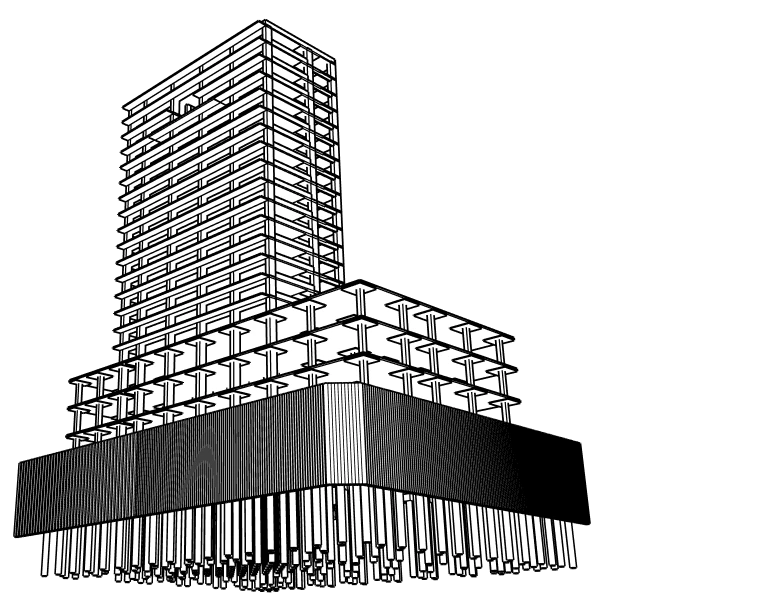
The impact of lateral and vertical loads
In all buildings, but particularly tall buildings, the core must be designed to be stiff enough to limit deflections, total and inter-storey, from lateral loads from wind and seismic. With side core buildings however, these forces are applied to the building eccentric to the centre of stiffness, creating a torsional twist which amplifies the lateral displacement, particularly at the corner columns.
The lateral movement under lateral loads is perhaps an obvious consequence of the side core, but there is another less intuitive and potentially more punitive structural consequence of the side core. This situation is at its most extreme when we have a façade to core floor span with no internal columns. Here, as around half of the total floor load is supported on the inside edge of the core, the load is both very significant and axially eccentric to the centre of stiffness of the core. This means that Vertical Dead and Live Loads will induce lateral sway and curling of the core. In tall buildings this can be very significant for lift shafts in particular as the lift installer will expect a “plumb” shaft to be able to execute their installation.
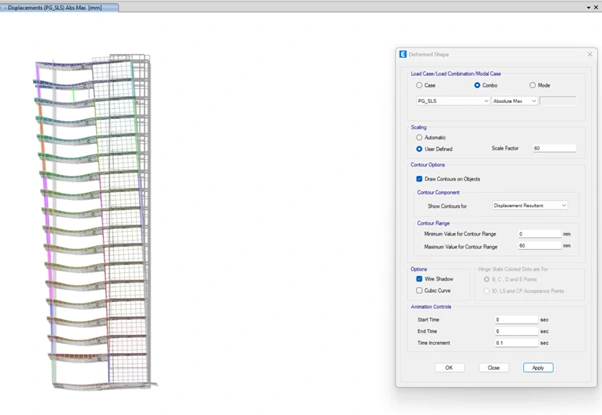
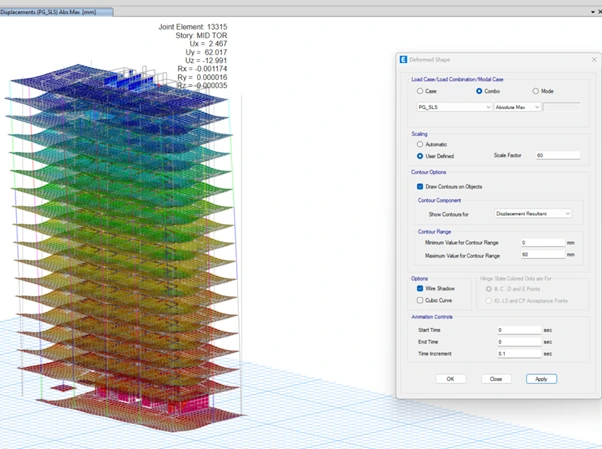
Predicting movement and prestressing
The method in which the structure is constructed affects how large this vertical dislocation will be, but also potentially offers the opportunity to control the gross value of the dislocation. If the core is slip formed many storeys ahead of the floor plates it is likely to be necessary to predict the movement of the core and preset it out of position, allowing the dead loads of the floors to pull the core progressively back towards its theoretical vertical position. This technique was used on 240 Blackfriars where the affectionately named “banana” core was built curved up to 90mm from its theoretical vertical position. When all floors were applied the core was within 10mm of its theoretical position.
Other methods of dealing with this effect is to oversize the core and the door openings at each floor to accommodate the tolerance, or to introduce prestressing tendons into the unloaded back edge and apply a force between top and G floor to force the whole core to have an even internal stress distribution.
Prestressing this way can reduce or eliminate the differential stresses that create curling and sway in the core, but the prestress forces are internal. It is essential to ensure that the centre of load for the weight of the core and the floors it supports is aligned to the centre of resistance from the foundations so that differential settlement at foundations across the width of the core is eliminated or effectively controlled. It should be noted that a 5-10mm differential settlement which occurs across the width of the core can be amplified 10 or more times when this rotation is extrapolated to the whole height of the building.